
Research use resources
TB-500 purity: how to read a TB-500 lab report
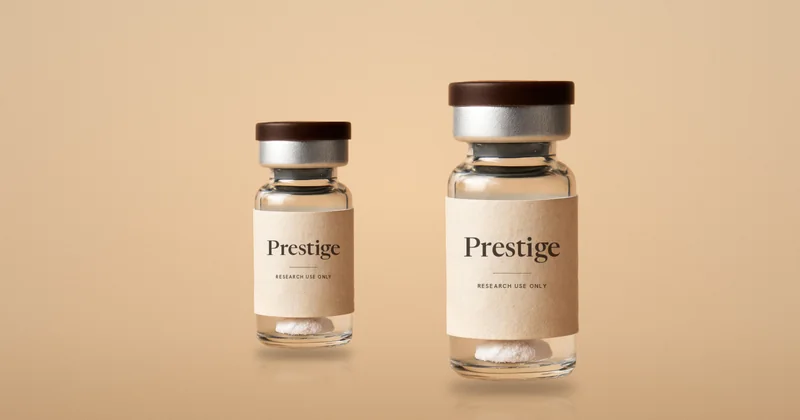
TB-500 is the longest peptide we carry, and a long peptide gives a lab report more to check. This guide covers what a TB-500 certificate of analysis (COA) should show, what tends to go wrong when a 43 amino acid chain is made, and how to check ours. For the basics of any report, see How to read a peptide lab report.
The short version
What TB-500 is, chemically
The TB-500 on our product page is thymosin beta-4: a chain of 43 amino acids with an acetyl group on the first one (written Ac).
| Reference fact | TB-500, as on our product page |
|---|---|
| Length | 43 amino acids, acetyl group on the first |
| Form | Freeze dried (lyophilized) powder |
Purity: what a long chain adds
Peptides are built one amino acid at a time. With 43 steps, small slips add up: a chain can miss one amino acid (a deletion) or stop early (a shortened chain). Those near copies come off the HPLC column close to the main peak, which is why a long peptide’s chromatogram usually shows more small peaks than a short one’s. Purity is the main peak’s share of all of them.
Our TB-500 report from Janoshik Analytical (test #169295, June 2026) shows 99.21% purity.
Identity: confirmed by mass spec
Mass spectrometry confirms the main peak is TB-500 by weighing it. A molecule this size picks up several charges in the instrument, so the raw reading is a row of peaks, one for each charge. Labs convert that row back into a single mass, and the report should state that it matches the compound named on it.
The 7 amino acid fragment (Ac-LKKTETQ) has a much smaller mass than the full chain. Both are sold as TB-500, and the mass is the quickest way to tell which one a report describes.
Oxidation: the one to watch
Methionine, the sixth amino acid, can pick up an oxygen atom when the peptide is exposed to air, light or heat. The oxidized version carries one extra oxygen atom and usually shows as a small extra peak near the main one. A clean report shows little or none of it. Keeping the powder sealed, cold and dark (our product page says −20 °C, away from light) is what keeps it that way.
TB-500 in blends
TB-500 is also part of our blends: BPC-157 + TB-500, KLOW and GLOW. In a blend, look for each part named on the report and identified by its own mass. Kovera’s blend reports, for example, give the blend’s averages and then a section for the components.
Our TB-500 report
Our TB-500 is listed with a report from Janoshik Analytical, test #169295 (June 2026): 99.21% purity. The link on the product page opens the report on Janoshik’s own site (verify.janoshik.com), so you see it straight from the lab, not a copy. Like every report, it covers the sample that was tested, and the product page says so when the current lot isn’t confirmed as that sample.
Checking a TB-500 report, step by step
- The name: TB-500 or thymosin beta-4, matching the product you are looking at.
- Identity confirmed by mass spec as the full chain, not the short fragment.
- Purity from HPLC, with the method shown.
- Little or no oxidized form on the HPLC trace.
- The report number opens the same report on the lab’s own site.
Common questions
Is TB-500 the same as thymosin beta-4?
Sellers use the name both ways: for the full 43 amino acid chain, as we do, and for the 7 amino acid fragment. The mass on the report settles which one a vial holds.
Why does the mass spec show several peaks for one peptide?
Each of those peaks is the same molecule carrying a different number of charges. The lab combines them into the one mass you see on the report.
Where do I find the TB-500 report?
On the TB-500 product page under Specifications & documentation, and on our research materials page, which lists every report.