
Research use resources
BPC-157 lab report: what to check on a BPC-157 COA
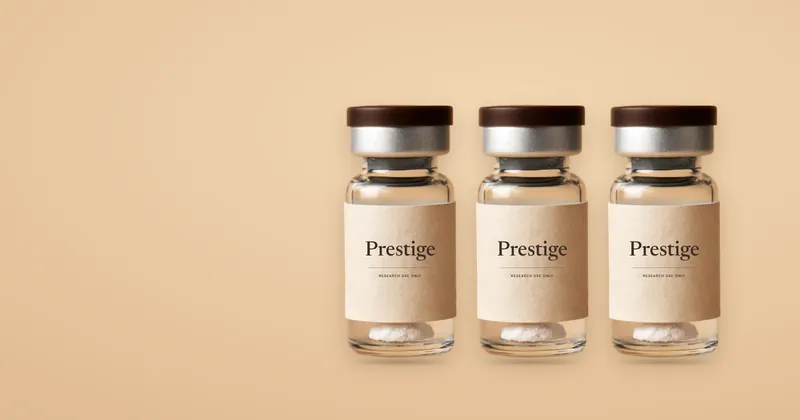
BPC-157 is a synthetic chain of 15 amino acids, and one of the most tested research peptides there is. Its lab report answers the same three questions as any other (how pure, what it is, how much), but the chain itself gives each answer something specific to look for: four prolines, a pair of aspartic acids side by side, and no amino acid that absorbs much ultraviolet light. This guide covers what a BPC-157 certificate of analysis (COA) should show and how to check our own report. For the basics of any report, see How to read a peptide lab report.
The short version
What BPC-157 is, chemically
BPC-157 is a straight chain: glycine, glutamic acid, three prolines, glycine, lysine, proline, alanine, two aspartic acids, alanine, glycine, leucine and valine. It has no ring, no added groups at either end and no unusual amino acids.
| Reference fact | BPC-157, as on our product page |
|---|---|
| Sequence | Gly-Glu-Pro-Pro-Pro-Gly-Lys-Pro-Ala-Asp-Asp-Ala-Gly-Leu-Val |
| One letter code | GEPPPGKPADDAGLV |
| Form | Freeze dried (lyophilized) powder, 10mg vials |
Purity: a low wavelength and three things to look for
Purity comes from HPLC: the sample runs through a column, a UV detector draws a peak for each component, and purity is the BPC-157 peak as a share of every peak. BPC-157 has no tryptophan, tyrosine or phenylalanine, the amino acids that absorb strongly at 254 or 280 nm, so the detector has to read it near 214 nm, where the bonds between amino acids absorb. A report should name its wavelength; a purity read at 280 nm would hardly see BPC-157 at all.
On a BPC-157 trace, the small peaks worth knowing are:
- Chains missing an amino acid. Each step of synthesis adds one amino acid, and a step that doesn’t finish leaves a slightly shorter chain. With three prolines in a row, a chain short one proline is a typical example.
- An aspartimide. At an aspartic acid, the chain can fold back on itself and lose a water molecule, forming a small ring. The two aspartic acids side by side make this the by-product to look for on BPC-157.
- A shoulder on the main peak. Prolines can twist into two shapes that slowly swap, which can widen the main peak or give it a small shoulder. It is still BPC-157, so a good method counts it as part of the main peak.
Keeping the powder sealed, cold and dry keeps these small: our product page lists minus 20 °C or colder, away from light and moisture. For how purity differs from the amount in the vial, see Purity vs content.
Identity: what mass spec confirms
Mass spectrometry confirms the main peak is BPC-157 by weighing it. The report should state that the measured mass matches BPC-157, the compound named on it. Some labs print the measured values, and others give the result as the compound’s name or as Conforms.
BPC-157 is sometimes sold as a salt, such as an acetate or an arginate. The salt adds weight to the powder, but the mass spectrometer still weighs the peptide itself, so the identity result stays the same. The salt shows up in content instead: it is part of why the powder weighs more than the BPC-157 in it.
Content: milligrams, not percent
Content is how many milligrams of BPC-157 the lab measured in the vial. It is not the same as purity: a sample can be 99% pure BPC-157 and still hold less than its label, or more. A report that lists content per vial, in milligrams or as a percent of the label, answers the question the label asks. Like every result, it describes the one vial tested.
Our BPC-157 report
Our BPC-157 is listed with a report from Janoshik Analytical, test #169235 (June 16, 2026): 99.68% purity for a 10mg vial. The link on the product page opens the report on Janoshik’s own site (verify.janoshik.com), so you see it straight from the lab, not a copy. Like every report, it covers the sample that was tested, and the product page says so when the current lot isn’t confirmed as that sample.
Checking a BPC-157 report, step by step
- Name and sequence: BPC-157, GEPPPGKPADDAGLV.
- Purity from HPLC, 98% or higher, read near 214 nm, with no large aspartimide peak.
- Identity from mass spec: the report states that the measured mass matches BPC-157.
- Content in milligrams, close to or above the 10mg on the label.
- The report number opens the same report on the lab’s own site, #169235 for ours.
Common questions
Does the salt form change the lab report?
Not the purity or the mass: both are about the peptide itself. It can change content, because part of the powder’s weight is the salt. That is why content in milligrams of BPC-157 is the number to compare with the label.
Why is the purity read at 214 nm?
BPC-157 has none of the amino acids that absorb at higher wavelengths, so 214 nm, where every bond between amino acids absorbs, is the wavelength that sees the whole chain and its near copies.
Where do I find the BPC-157 report?
On the BPC-157 product page under Specifications & documentation, and on our research materials page, which lists every report.