
Research use resources
Epithalon lab report: what to check on an Epithalon COA
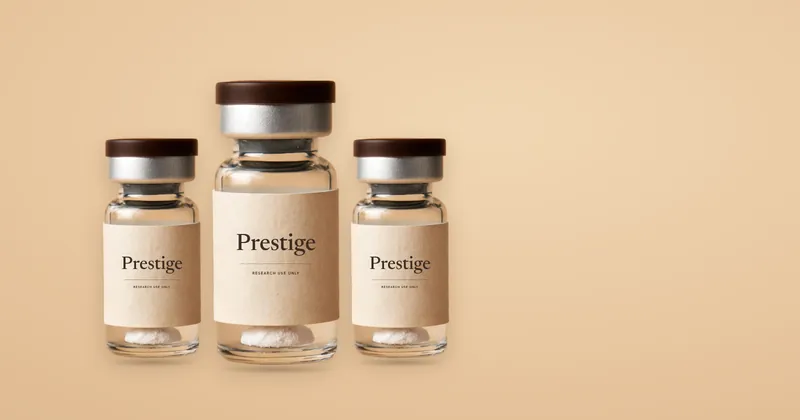
Epithalon (also written Epitalon) is one of the smallest peptides in research use: four amino acids. Being that small changes how its lab report reads. It barely absorbs ultraviolet light, it is hard to hold on a standard HPLC column, and the two amino acids at its end form one of the best known weak spots in peptide chemistry. This guide covers what an Epithalon certificate of analysis (COA) should show and what to check first. For the basics of any report, see How to read a peptide lab report.
The short version
What Epithalon is, chemically
Epithalon is a straight chain of four amino acids: alanine, glutamic acid, aspartic acid and glycine, written AEDG from their one letter codes. It carries three acid groups (on the side chains of glutamic and aspartic acid, and at the end of the chain), which makes it very water friendly and gives it a negative charge in most solutions.
| Reference fact | Epithalon, as on our product page |
|---|---|
| Sequence | Ala-Glu-Asp-Gly |
| One letter code | AEDG |
| Form | Freeze dried (lyophilized) powder, 10mg vials |
Purity: what makes a small peptide harder to measure
Purity comes from HPLC: the sample runs through a column, a UV detector draws a peak for each component, and purity is the main peak as a share of every peak. Two things make this harder for Epithalon than for a larger peptide:
- Weak UV signal. None of its amino acids has a ring that absorbs at 254 or 280 nm, so the detector has to read it at a low wavelength, around 205 to 214 nm, where only the bonds between amino acids absorb. A report should name its wavelength.
- Little grip on the column. Small, charged and water friendly, Epithalon tends to come off a standard reversed phase column early, close to where the solvent itself shows up. A good method holds it long enough to separate it from that early signal; a main peak sitting right on the solvent front is hard to measure cleanly.
On an Epithalon trace, the small peaks worth knowing are:
- An aspartimide. Aspartic acid followed by glycine is the pair most prone to fold into a small ring and lose a water molecule.
- The iso form. When that ring opens again, it can reattach the chain through a different carbon, giving a form with exactly the same mass as Epithalon. Only the HPLC trace can show it, as a separate peak near the main one.
- Chains missing an amino acid, left from a synthesis step that didn’t finish. In a chain this short, each one is a quarter of the molecule, so they are easy to tell apart by mass.
Moisture and warmth speed up the aspartimide change, which is why the powder is stored sealed, dry and cold. For how purity differs from the amount in the vial, see Purity vs content.
Identity: what mass spec confirms
Mass spectrometry confirms the main peak is Epithalon by weighing it. The report should state that the measured mass matches Epithalon, the compound named on it. Small acidic peptides like this one often pick up a sodium ion as well as a proton in the instrument, so a spectrum can show two main signals that both belong to Epithalon. The sodium signal is not an impurity: it is the same molecule.
Content: milligrams, not percent
Content is how many milligrams of Epithalon the lab measured in the vial. It is a separate number from purity, because the powder also holds salts and a little water. A report that gives content per vial, in milligrams or as a percent of the label, answers the question the label asks.
Our Epithalon reports
Epithalon is new on our site. Independent lab reports are linked on its product page as they come in; none is posted yet. Contact us and we will send the documentation for the lot you receive. When a report is posted, the checks below are the ones to run on it.
Checking an Epithalon report, step by step
- Name and sequence: Epithalon or Epitalon, Ala-Glu-Asp-Gly.
- Purity from HPLC, 98% or higher, read at a low wavelength, with the main peak clear of the solvent front.
- Identity from mass spec: the report states that the measured mass matches Epithalon.
- Content in milligrams, close to or above the 10mg on the label.
- The lab and report number, matching the report linked on the product page.
Common questions
Are Epithalon and Epitalon the same?
Yes, two spellings of the same four amino acid peptide. Reports may use either; the sequence is what to match.
Why can a spectrum show two signals for Epithalon?
Small peptides often pick up a sodium ion in the instrument as well as a proton. Both signals come from the same molecule, so the second one is not an impurity.
Where will the Epithalon report be?
On the Epithalon product page under Specifications & documentation, and on our research materials page, which lists every report.