
Research use resources
NAD+ lab report: what to check on an NAD+ COA
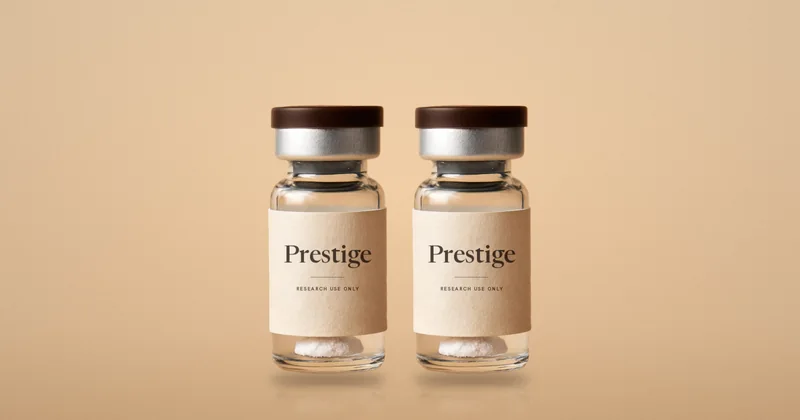
NAD+ is not a peptide. It has no amino acids at all: it is a coenzyme made of two nucleotides. Its lab report still answers the same three questions as any other report (how pure, what it is, how much), but the numbers look different from a peptide’s. This guide covers what an NAD+ certificate of analysis (COA) should show and walks through our own report. For the basics of any report, see How to read a peptide lab report.
The short version
What NAD+ is, chemically
NAD+ stands for nicotinamide adenine dinucleotide, in its oxidized form. It is two nucleotides joined through their phosphate groups: one carries nicotinamide, the other adenine, and each sits on a ribose sugar. In the laboratory it is a standard reagent in redox reactions, where it takes up electrons and becomes NADH.
| Reference fact | NAD+, as on our product page |
|---|---|
| Full name | Nicotinamide adenine dinucleotide (oxidized form) |
| Form | Freeze dried (lyophilized) powder, 500mg and 1000mg vials |
Purity: what the small peaks would be
Purity comes from HPLC with a UV detector: the sample runs through a column, and each component draws its own peak. The adenine part of NAD+ absorbs ultraviolet light strongly near 260 nm, so NAD+ gives a clear signal, and so does almost anything related to it. Purity is the NAD+ peak as a share of every peak the detector picks up.
On an NAD+ report, the small peaks worth knowing are:
- NADH, the reduced form. It also absorbs at 340 nm, where NAD+ does not, which is how a lab tells the two apart.
- Nicotinamide and ADP ribose, the two pieces NAD+ splits into as it breaks down. That happens faster in solution, in warmth and in alkaline conditions, which is why the powder is kept dry, cold and sealed.
Our report shows a single main NAD+ peak and a purity of 99.98%. For how purity differs from the amount in the vial, see Purity vs content.
Identity: confirmed by mass spec
Mass spectrometry confirms the main peak is NAD+ by weighing it. The report should state that the measured mass matches the compound named on it. The instrument adds one or two protons to the molecule, so the same compound can show up at more than one place on the spectrum.
A spectrum can also show two smaller signals from a little NAD+ breaking inside the instrument, at the bond that holds the nicotinamide. Seeing both pieces is extra confirmation: together they add up to the whole molecule.
Content: hundreds of milligrams, not a few
Most peptide vials hold tens of milligrams. NAD+ vials hold 500 or 1000, so its content is reported in hundreds of milligrams. The number to compare with the label is content (milligrams of NAD+ the lab measured), not purity.
Our 1000mg report found 1,084.87 mg of NAD+, about 8% more than the label. Like every report, it describes the vial that was tested, so other vials can land a little above or below that.
Our NAD+ report
Our NAD+ 1000mg size is listed with a report from Freedom Diagnostics: NAD 1000mg, purity 99.98% by HPLC with UV detection, identity confirmed as NAD+ by LC-MS, net content 1,084.87 mg, appearance white lyophilized powder. The report shows its chromatogram and its mass spectrum, and carries the lab’s name and website. Our research materials page also links a Janoshik Analytical test for a 500mg vial (#169302), which opens on Janoshik’s own site.
Storage and the report
A report describes the powder on the day it was tested. Keeping it close to that is mostly about the breakdown described above: our product page lists sealed vials in a freezer at minus 20 °C or colder, away from light and moisture, and letting a cold vial reach room temperature before opening it so no water condenses inside. Recording the lot number with your lab notes keeps every result traceable to its report.
Checking an NAD+ report, step by step
- The name: NAD+ (nicotinamide adenine dinucleotide, oxidized form), not NADH.
- Purity from HPLC, 98% or higher, with one main peak.
- Identity confirmed as NAD+ by mass spec (LC-MS).
- Content in milligrams, close to the size on the label (500mg or 1000mg).
- The lab named on the report, with its own website, so the report can be traced to it.
Common questions
Is NAD+ a peptide?
No. It is a dinucleotide, with no amino acids. It is tested the same way as our peptides, though: HPLC for purity and mass spectrometry for identity.
What is the difference between NAD+ and NADH on a report?
NADH is the reduced form, what NAD+ becomes when it takes up electrons, so it is a different compound with its own report. On the HPLC trace it comes off the column at a different time and absorbs at 340 nm, so a lab can tell the two apart.
Where do I find the NAD+ report?
On the NAD+ product page under Specifications & documentation, and on our research materials page, which lists every report.