
Research use resources
SS-31 lab report: what to check on an SS-31 COA
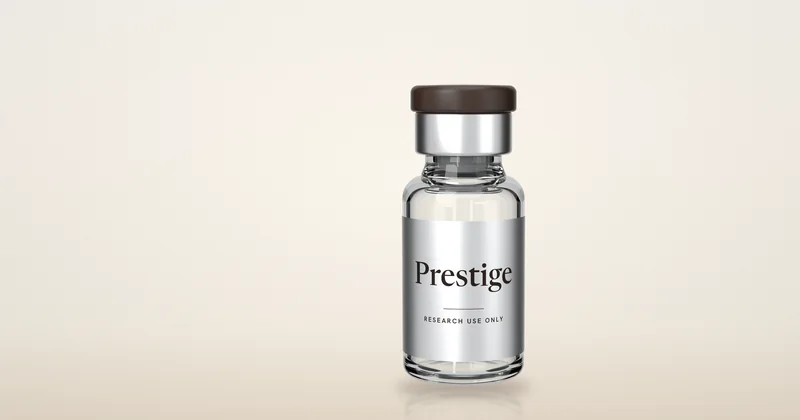
SS-31 is a short synthetic peptide of four amino acids, two of them changed from their usual form. A lab report has to confirm that exact molecule, and SS-31 has a few quirks that make its report worth reading closely. This guide covers what an SS-31 certificate of analysis (COA) should show and walks through our own report. For the basics of any report, see How to read a peptide lab report.
The short version
What SS-31 is, chemically
SS-31 is a tetrapeptide with the sequence D-Arg-Dmt-Lys-Phe-NH2. Two of its four amino acids are not the usual ones. Arginine comes first in its D form, the mirror image of the form found in most peptides. Dmt is a tyrosine with two extra methyl groups on its ring. The chain ends in an amide (NH2) instead of a free acid. Arginine, lysine and the amino group at the start of the chain can each carry a positive charge, which matters for the mass spectrum below.
| Reference fact | SS-31, as on our product page |
|---|---|
| Sequence | D-Arg-Dmt-Lys-Phe-NH2 (Dmt = dimethyltyrosine) |
| Form | Freeze dried (lyophilized) powder in sealed glass vials |
| Tested size | 10mg |
Purity: the one impurity mass spec can’t see
Purity comes from HPLC with a UV detector: the sample runs through a column, and each component draws its own peak. Purity is the SS-31 peak as a share of every peak the detector picks up. Dmt and phenylalanine both have ring shaped side chains that absorb ultraviolet light, so SS-31 gives a clear signal for a peptide of its size.
On an SS-31 report, the small peaks worth knowing are:
- Shorter chains, missing one of the four amino acids, left over from making the peptide. Each one weighs clearly less, so mass spec can tell it apart.
- The version with ordinary arginine in place of D arginine. It has exactly the same mass, so the mass spectrum can’t tell the two apart. The HPLC trace is where it can show up, as a second peak close to the main one. That is why the check is purity with no large peak right next to the main one.
Our report shows one sharp peak labeled SS-31 on a nearly flat baseline, and a purity of 99.89%. For how purity differs from the amount in the vial, see Purity vs content.
Identity: one molecule, more than one signal
Mass spectrometry confirms the main peak is SS-31 by weighing it. The instrument reads mass divided by charge, and because SS-31 has three places that can hold a positive charge, the same molecule can pick up one, two or three protons. Each charge state lands at its own place on the spectrum, so a correct SS-31 spectrum shows a small family of signals, not one.
Our report labels two of them: SS-31 with one charge and SS-31 with two. It also prints a signal that fits SS-31 with three charges and one that fits SS-31 carrying a sodium ion, a common trace from lab solvents and glassware. Small signals just above the main ones are normal too: they come from molecules that carry a heavier carbon, nitrogen or oxygen atom. The labeled signals are the ones that identify SS-31, and both match.
Content: SS-31 itself, not the powder
Content is the milligrams of SS-31 the lab measured in the vial, not the weight of the powder. Each of SS-31’s charged groups can hold a counter ion (a salt) left over from making and purifying it, and a freeze dried powder also holds a little water, so the powder weighs more than the SS-31 inside it.
Our 10mg report found 14.73 mg of SS-31, well above the 10mg on the label. Like every report, it describes the vial that was tested, so other vials can land above or below that. The number to compare with the label is this content figure, not purity.
Our SS-31 report
Our SS-31 10mg size is listed with a report from Freedom Diagnostics: SS-31 10mg, purity 99.89% by HPLC with UV detection, identity confirmed as SS-31 by LC-MS, net content 14.73 mg, appearance white lyophilized powder. The report shows its chromatogram and its mass spectrum, and carries the lab’s name and website. It names the product and size rather than a lot number, and the product page notes that the report applies to the tested sample and that the current lot is not confirmed as that sample.
Storage and the report
A report describes the powder on the day it was tested. Our product page lists sealed vials at minus 20 °C or colder, dry and away from light. For why each of those matters for a peptide like SS-31, see How to store lyophilized peptide vials.
Checking an SS-31 report, step by step
- The name and sequence: SS-31, D-Arg-Dmt-Lys-Phe-NH2, matching the product and size you are looking at.
- Purity from HPLC, 98% or higher, with no large second peak close to the main one.
- Identity by mass spec, with SS-31 labeled at more than one charge.
- Content in milligrams of SS-31, compared with the size on the label.
- The lab named on the report, with its website, and the sample or lot the report covers.
Common questions
Can mass spec tell D arginine from ordinary arginine?
No. The two versions have the same mass. On a report like this, the difference can only show up in the HPLC trace, as a second peak close to the main one. Our report shows a single main peak.
Why did the vial hold more than 10mg?
Vials are filled one at a time, and labs report exactly what they measure. Our tested 10mg vial held 14.73 mg of SS-31. Other vials can land above or below that.
Where do I find the SS-31 report?
On the SS-31 product page under Lab results, and on our research materials page, which lists every report. Our other research peptides list their reports the same way.