
Research use resources
How to store lyophilized peptide vials: cold, dry and dark
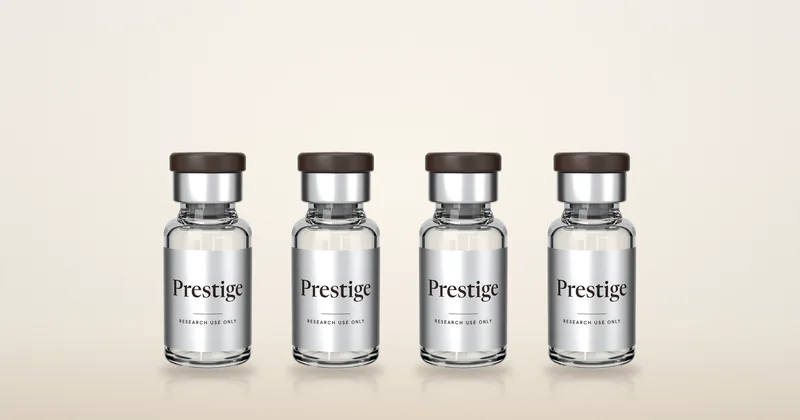
Almost everything we sell arrives as a lyophilized (freeze dried) powder in a sealed glass vial. In that form a peptide is at its most stable, and how long it stays that way comes down to three things: temperature, moisture and air. This guide covers how to store sealed vials so the powder stays as close as possible to what its lab report describes, and why each step matters.
The short version
Why peptides come freeze dried
Freeze drying removes the water from a material while it is frozen, leaving a dry cake or powder. Most of the ways a peptide breaks down need water, so a dry powder is far more stable than the same peptide in solution. It also means the milligrams on the label describe the peptide itself. Storage is about keeping it that way: cold, dry and away from air.
Temperature: the freezer, not the fridge
Our product pages list sealed vials at minus 20 °C or colder. That matches the published handling guides: Sigma-Aldrich recommends minus 20 °C, or preferably minus 80 °C, for long term storage of dry peptides, and notes that some peptides are also stable at 4 °C. GenScript puts most dry peptides stored this way at stable for several years, with the exact time depending on the sequence.
In practice, a standard laboratory freezer at minus 20 °C is the right home for sealed vials you plan to keep. A minus 80 °C freezer is better for anything you will hold for a long time.
Moisture: the reason to wait before opening
Moisture is the biggest threat to a dry peptide. The most common way it gets in is also the easiest to avoid: opening a vial straight from the freezer. Cold glass pulls water out of the room air, and that water condenses on and inside the vial. Both guides give the same instruction: let the vial reach room temperature before you open it, and keep it tightly capped whenever it is not in use.
Some amino acids make a peptide take up moisture from the air more readily. GenScript names aspartic acid, glutamic acid, lysine, arginine and histidine, and recommends storing such peptides in a desiccator (a sealed container with a drying agent) in a tightly capped vial.
Air: the amino acids that oxidize
Oxygen slowly reacts with a few amino acids. Both guides name cysteine, methionine and tryptophan as the ones prone to air oxidation, and Sigma-Aldrich suggests replacing the air in an opened vial with nitrogen or argon for peptides that contain them. On a lab report, oxidation shows up as a small extra peak close to the main one, and a slightly lower purity on a later test.
Here is what to watch for, with examples from our own catalog:
| Amino acids | Why they matter | In our catalog |
|---|---|---|
| Methionine (Met), cysteine (Cys), tryptophan (Trp) | React with oxygen in the air over time (oxidation). | VIP has one methionine; Semax starts with one; Melanotan II contains tryptophan. |
| Aspartic acid, glutamic acid, lysine, arginine, histidine | Take up moisture from the air. | Pinealon (Glu-Asp-Arg) is made of three of them; KPV (Lys-Pro-Val) starts with lysine. |
Light
Keep vials away from bright light. Both guides say so, and our product pages list it for every powder. A closed freezer takes care of this on its own; the time to think about it is when vials sit out on a bench.
Repeated freezing and thawing
Sigma-Aldrich advises against freezing and thawing a dry peptide over and over. Each trip out of the freezer is a chance for the vial to warm, collect moisture and take in air. The simple rule: keep sealed vials in the freezer until you need them, and take out only the vial you need.
Not every vial is a powder
A few things we carry are liquids, and the advice above is for dry powders only. A liquid’s storage is listed on its own product page; where a page lists none, ask us before you order.
What storage has to do with the lab report
A lab report describes the powder on the day it was tested. Good storage keeps your vial close to that snapshot; poor storage shows up later as new small peaks on a trace and a lower purity. NAD+ is a good example: it breaks into smaller pieces faster in warmth and moisture, which our NAD+ lab report guide covers. For what the peaks and percentages on a report mean, see How to read a peptide lab report, and for why the amount in the vial is a separate number from purity, see Purity vs content.
When your order arrives
- Check the seals and the labels. Tell us within 7 days if anything arrived damaged or wrong.
- Note each lot number from the label with your lab records.
- Put the sealed vials in the freezer, at minus 20 °C or colder, away from light.
- Before opening one, let it reach room temperature, then keep it tightly capped.
- Keep the lab report for each lot with your records; the QR code on the label opens it.
Common questions
Can lyophilized peptides be kept at room temperature?
For long term storage, no: the guides recommend minus 20 °C or colder, and Sigma-Aldrich notes that some peptides are stable at 4 °C. Our product pages list minus 20 °C or colder for every powder.
Fridge or freezer?
Freezer. A fridge at about 4 °C is fine for some peptides, but the freezer is the standard for sealed vials you plan to keep, and it is what our product pages list.
How long do sealed peptide vials keep?
GenScript describes most dry peptides stored cold, dry and away from light as stable for several years, depending on the sequence. Peptides with methionine, cysteine or tryptophan, or with many moisture loving amino acids, need the most care.
Where do I find the storage line for a product?
On each product page under Specifications & documentation. You can browse our research peptides and peptide blends, or see every report on our research materials page.
Sources
Sigma-Aldrich, Handling and Storage Guidelines for Peptides, and GenScript, Peptide Storage and Handling, both read November 15, 2026. Our products are sold for in vitro laboratory research only, not for human or animal use.