
Research use resources
Reta lab report: what to check on a Reta COA
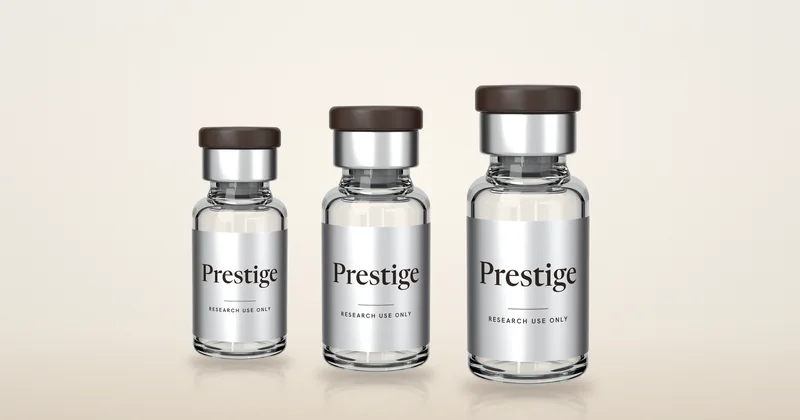
Reta is our most ordered research peptide, and it has four lab reports behind it from three independent labs, covering all three sizes. This guide covers what a Reta certificate of analysis (COA) should show, what each of our four reports found, and how to check that the report you are reading belongs to the vial in front of you. For the basics of any report, see How to read a peptide lab report.
The short version
Reta in our catalog
Reta is a synthetic peptide supplied as a lyophilized (freeze dried) powder in sealed glass vials, in three sizes: 10mg, 20mg and 30mg. Each vial carries a lot number on its label, and the QR code on the label opens the lab report for that lot. Reta is sold for in vitro laboratory research only, not for human or animal use.
Our four Reta reports
Every Reta report we have is listed below, newest first. The numbers are copied from the reports as the labs issued them, the same ones you see under Lab results on the Reta product page.
| Size | Lab and report | Purity | Found in the vial | Identity by |
|---|---|---|---|---|
| 30mg, lot 20261030 | ILS Laboratories, COA-2026-KUDA2P, November 9, 2026 | 99.71% | 30.8 mg | HPLC retention time against a reference standard |
| 10mg, lot 20260117 | TrustPointe Analytics, SPL-5108, October 30, 2026 | 99.708% | 9.196 mg | Retention time and spectral match |
| 20mg | Kovera Labs, KVR-2026-51FE8D, September 7, 2026 | 99.439% | 22.36 mg | Mass spectrometry |
| 10mg (earlier vial) | Kovera Labs, KVR-2026-C5B384, September 7, 2026 | 99.442% | 11.56 mg | Mass spectrometry |
Four reports from three labs, all between 99.4% and 99.8% purity. That agreement matters more than any single number: different labs, different instruments and different vials landing in the same narrow range is good evidence that the material is consistent from lot to lot.
Purity: what the percentage measures
Purity comes from high performance liquid chromatography (HPLC). The sample runs through a column, each component comes off at its own time, and a detector draws a peak for each one. Purity is the Reta peak as a share of everything the detector picks up.
Reta is a long peptide, so the small peaks worth watching for are chains that came out of synthesis one amino acid short, or a version with one amino acid changed. They behave almost like Reta in the column, so on a good trace they show up as small peaks close to the main one. A purity above 99% means there is very little room left for them.
ILS prints its pass mark next to the result: 95.0% or higher. Our 30mg lot read 99.71% against that mark. For how purity differs from the amount in the vial, see Purity vs content.
Identity: three labs, three ways to confirm it
Purity says how clean the main peak is. Identity says what the main peak is. Our three labs confirmed identity in three different ways, and it helps to know what each one means:
- Mass spectrometry (Kovera Labs). The instrument weighs the molecule. A long peptide like Reta picks up several charges at once, so it shows up as a family of signals that all point back to the same mass. This is the most specific of the three.
- Retention time and spectral match (TrustPointe Analytics). The lab compares when the peak comes off the column, and the shape of its ultraviolet signal, with a reference.
- HPLC retention time against a reference standard (ILS Laboratories). The lab runs a known reference sample on the same system and confirms that our main peak comes off at the same time. ILS lists it as Identity (HPLC RTM): Confirmed.
Each report states that identity was confirmed. When you read a Reta report from anyone, look for that line and for the method next to it.
Content: what was actually in the vial
Content is the number to compare with the label. It is the milligrams of Reta the lab measured in the vial, not the weight of the powder (a freeze dried peptide also holds a little water and salt). Our four reports found 30.8 mg in a 30mg vial, 22.36 mg in a 20mg vial, 11.56 mg in an earlier 10mg vial and 9.196 mg in the October 10mg vial.
Every vial is filled separately, so amounts vary a little from vial to vial, and labs report exactly what they found. That is also why one report covers the vial that was tested, and why the lot number is the link between a report and the vial you hold.
The lot number: matching a report to your vial
Our two newest Reta reports name a lot: 20261030 for the 30mg size and 20260117 for the 10mg size. That lot number is printed on the vial’s label, and the QR code next to it opens the report for that lot on our website. If the lot on your label and the lot on the report match, the report describes your batch. The two September reports from Kovera Labs describe the vials that were tested, and the product page says so when a report’s lot isn’t confirmed as the lot being shipped.
New Reta lots go to ILS Laboratories. To read one of their certificates line by line, see How to read an ILS Laboratories COA.
Other lines on a Reta report
The ILS certificate for our 30mg lot also lists a fentanyl screen by immunoassay, at a 50 ng/mL cutoff: not detected. It records the date the lab received the sample (November 2) and the date it analyzed it (November 9), and it names Prestige Peptides as the client, so you can see the report was made for us and not borrowed from another seller.
Checking a Reta report, step by step
- The name and size: Reta, in the size you are looking at (10mg, 20mg or 30mg).
- The lot number on the report matches the lot on your vial’s label.
- Purity from HPLC, 98% or higher, with one main peak.
- Identity confirmed, with the method named next to it.
- Content in milligrams, close to the size on the label.
- The lab and the client are named, and the report can be traced back to the lab.
Common questions
Which labs have tested your Reta?
Three: ILS Laboratories (30mg, lot 20261030), TrustPointe Analytics (10mg, lot 20260117) and Kovera Labs (20mg and an earlier 10mg vial). All four reports are linked on the Reta product page.
What purity is your Reta?
Between 99.439% and 99.71% across our four reports. The newest, the 30mg lot from ILS Laboratories, read 99.71%.
Why does the amount found differ from the size on the label?
Each vial is filled on its own and labs report exactly what they measure, so the result lands a little above or below the label. Compare content, not purity, with the size on the label.
How should Reta vials be stored?
Sealed, at minus 20 °C or colder, dry and away from light, as the product page lists. For why each of those matters, see How to store lyophilized peptide vials.
Where do I find the Reta reports?
On the Reta product page under Lab results, for each size, and on our research materials page, which lists every report. Browse the rest of our research peptides the same way: each one lists its own reports.